
Do you also believe that eating healthy is all you need to lose weight?
We have all been there, googling for diet plans, following every healthy eating trend, yet the weight loss seems elusive. It can be frustrating when you’re making the right choices, but not seeing results.
The truth is, healthy eating alone might not be the solution. The real issue could lie in the calorie-deficit vs. healthy-eating weight-loss debate.
Let’s explore the hidden reasons behind your weight loss struggle.
Does Healthy Eating Always Lead to Weight Loss?
No, eating healthy doesn’t automatically mean weight loss. It is important to understand the role of calorie intake, portion sizes, and energy balance.
We all think that eating healthy foods will naturally help us shed pounds, but unfortunately, that’s not the case. It’s easy to overlook how even healthy foods can cause us to overeat, leading to an excess in calories.
Healthy fats, nuts, and avocados, for example, are nutrient-dense but calorie-rich, making it easy to consume more calories than intended.
Why Clean Eating Doesn’t Always Lead to Fat Loss
Many individuals find themselves stuck in a weight loss plateau despite eating clean. This is often because they don’t consider the calorie deficit vs the healthy-eating weight-loss factor.
It is not just about eating clean; it is about creating an energy imbalance, burning more calories than you consume.
- Portion control matters: Even healthy foods can contribute to excess calories if eaten in large amounts.
- Healthy foods can still be calorie-dense: Foods like nuts, oils, and grains are packed with calories.
- Mindful eating: Focusing on the nutritional value doesn’t always align with the calorie content.
What is the Role of a Calorie Deficit in Weight Loss?
Weight loss occurs only when you burn more calories than you consume, regardless of your food choices.
According to research, Calorie restriction (CR) requires adequate nutrition. The Minnesota Starvation Study showed that severe CR (~40%) with nutrient deficiency led to weight loss, weakness, reduced endurance, oedema (swelling caused by excess fluid trapped in the body’s tissues), and psychological distress. In contrast, moderate CR (~25%) with proper supplementation supports safe weight loss without adverse effects, highlighting the importance of nutritional adequacy. (SOURCE)
Understanding Energy Balance and Fat Loss
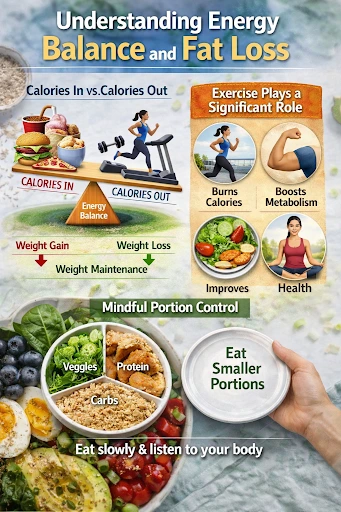
While a healthy diet is essential for well-being, understanding energy balance is crucial for weight loss. This includes tracking both calorie intake and expenditure through daily activities and exercise.
- Calories in vs. calories out: If you consume more than you burn, you’ll gain weight.
- Exercise plays a significant role: Movement increases calorie burn.
- Mindful portion control: Ensuring that your portions align with your energy needs.
How Does Portion Size Impact Weight Loss?
Even healthy foods can hinder weight loss if you eat larger portions than needed, leading to excess calories.
Portion Control and Weight Gain Despite Healthy Food: What You Might Be Missing
If your portions are too large, you’re still consuming too many calories. This is especially true for high-calorie foods like nuts, oils, and seeds, which are easy to overeat because they are nutrient-dense.
This is where guidance from an experienced dietitian in Kolkata, like Dt. Uma Bajoria can make a real difference. She will help you understand the right portion sizes for your body. So your healthy eating actually supports your weight-loss goals rather than working against them.
The Psychological Impact of Eating Healthy
It’s common to feel that eating healthy foods doesn’t need portion control because they’re considered “good” for you. However, this mindset can lead to overeating and ultimately prevent weight loss.
- Size matters: Serving sizes of nutrient-dense foods can be deceiving.
- Healthy does not mean low-calorie: Many healthy foods can have a high calorie density.
- Portion distortion: The tendency to serve larger portions of “healthy” foods can lead to weight gain.
Portion Sizes for Common Healthy Foods
| Food | Recommended Serving | Calories per Serving |
| Avocado | 1/4 medium | 60 kcal |
| Quinoa | 1/2 cup cooked | 110 kcal |
| Almonds | 1 oz (28g) | 160 kcal |
How Does Metabolism Impact Weight Loss?
Metabolism and weight loss resistance are closely linked, which is why weight loss often plateaus after initial progress.
Your metabolism can slow down during dieting, making weight loss harder, even if you’re eating healthy.
Metabolic adaptation, a natural process during dieting, is when your metabolism slows down to conserve energy in response to reduced calorie intake. This slowdown can make weight loss more challenging, even if you’re sticking to a healthy diet.
Why Weight Loss Plateaus Happen
When you lose weight, your body needs fewer calories to function. As your weight decreases, your metabolic rate slows, and your body adapts to a lower calorie intake.
- Reduced muscle mass: Slower metabolism leads to decreased calorie burn.
- Hormonal changes: Hormones like leptin and ghrelin can adjust to suppress hunger and regulate fat storage.
- Calorie reduction triggers survival mode: The body holds onto fat to protect itself from further calorie deficits.
Why Do Hormones Affect Weight Loss Despite Healthy Eating?
Hormones like insulin, cortisol, and thyroid hormones play a critical role in regulating fat storage and metabolism, potentially hindering weight loss.
Hormonal imbalances can be a major factor in why you might struggle with weight loss despite eating healthy. Insulin resistance, thyroid disorders, and high cortisol levels can lead to fat storage, particularly in the abdominal area, making it difficult to shed pounds.
How Hormonal Imbalances Affect Weight Loss
Conditions such as insulin resistance and weight loss difficulty can slow fat burning, causing weight gain even when eating a healthy diet. For instance, insulin resistance makes it harder to burn fat because your body is constantly storing it.
- High cortisol levels: Stress hormone causing abdominal fat storage.
- Thyroid function: An underactive thyroid slows metabolism, leading to weight gain.
- Insulin resistance: A condition where the body struggles to process glucose and burn fat.
Hormonal Influence on Weight Loss
| Hormone | Impact on Weight | Associated Conditions |
| Insulin | Fat storage | Insulin resistance |
| Cortisol | Abdominal fat | Chronic stress |
| Thyroid | Slowed metabolism | Hypothyroidism |
Healthy Food, Zero Results?
Achieving weight loss involves more than just eating healthy food. It’s about creating a calorie deficit, addressing hormonal imbalances, and ensuring metabolic health. Eating healthy is important, but it doesn’t automatically lead to weight loss without a proper calorie balance. Even nutritious foods can contribute to weight gain when portion sizes are overlooked.
Take control of your weight loss journey today – schedule a consultation with Dt. Uma Bajoria, a trusted dietitian in Kolkata, can provide expert insights into how you can break through your weight loss.
Call +91 9830614147 to book an appointment.
People Also Ask
- Can healthy food cause weight gain?
Yes, healthy food can cause weight gain if consumed in large portions or if calorie intake exceeds calorie burn. Even nutrient-dense foods like avocados, nuts, and whole grains are calorie-rich and should be consumed in moderation.
- Why am I not losing weight even after dieting?
If you are not losing weight despite dieting, it could be due to several factors, such as eating too many calories, slow metabolism, hormonal imbalances, or stress. A calorie deficit combined with exercise and a balanced approach is key to seeing results.
- How long does it take to see weight loss results?
The time it takes to see weight loss results varies from person to person. Typically, it takes about 2-4 weeks for visible changes, but sustainable weight loss requires consistent efforts over a few months.
- Does metabolism permanently slow after dieting?
Metabolism can temporarily slow down during dieting, especially when calorie intake is drastically reduced. However, once normal eating habits are restored, metabolism usually adapts and returns to baseline levels.
- Can hormonal problems stop weight loss completely?
Hormonal imbalances like insulin resistance, thyroid issues, and high cortisol levels can make weight loss difficult and slow. These issues can create barriers to fat burning, but with proper management and treatment, weight loss can still be achieved.